
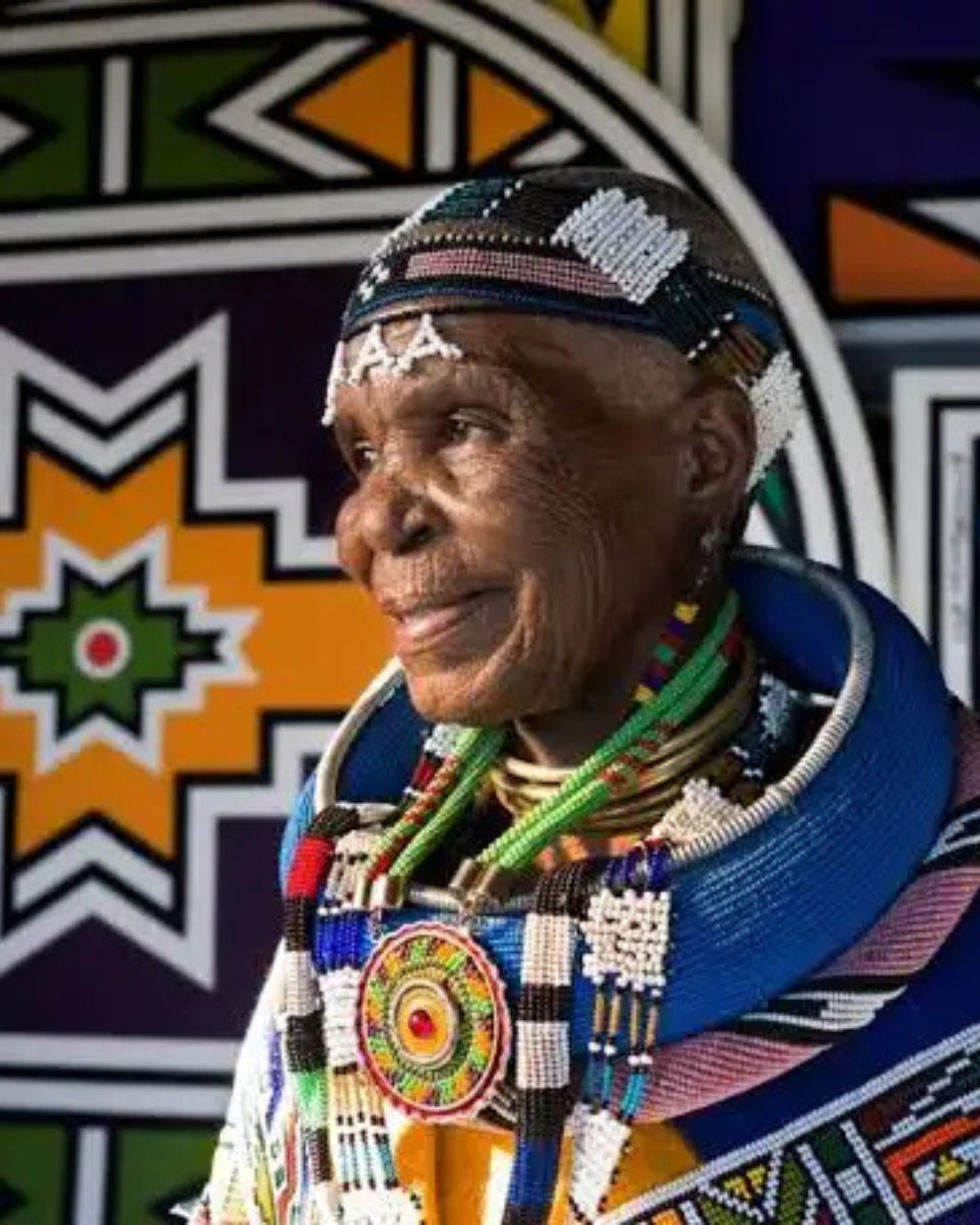
There are artists who follow trends, and there are artists who carry history in their hands. Esther Mahlangu belongs to the latter. Her work does not simply hang in galleries; it speaks of ancestry, womanhood, and resilience. It’s also the quiet continuity of African traditions that have survived against all odds.
Who is Esther Mahlangu?
Born in 1935 in Mpumalanga, South Africa, Mahlangu began painting as a young girl under the guidance of her mother and grandmother.
For the Ndebele people, painting was never a hobby or a profession. It was a language. Women painted the walls of their homes to mark celebrations, express identity, and communicate with the wider community. Every shape, every line, every color held meaning. Long before the world called her a contemporary artist, she was already part of a living visual culture.
Why is Esther’s sttory exceptional?
What makes her journey remarkable is not that she left tradition behind to become modern, but that she carried it with her. Using a steady hand and an instinctive sense of balance, she creates perfectly symmetrical geometric patterns without rulers, tape, or measurements.
Thick black outlines hold fields of bright color—turquoise, red, yellow, deep blue—forming compositions that feel both ancient and strikingly current. Her work has a rhythm, almost like music translated into form.
When did Esther begin her international career?
Her international breakthrough came when she began transferring these designs from house walls to canvas. Suddenly, a practice that had been dismissed for generations as “craft” entered the global fine art conversation.
Audiences in Europe and beyond were captivated. Here was something unmistakably African yet undeniably contemporary.


4
One of the most iconic moments in her career came in 1991 when she became the first African woman to design a BMW Art Car. The sleek surface of the vehicle became her canvas, wrapped in Ndebele geometry and color. It was more than a collaboration between art and engineering; it was a declaration that African visual language belongs everywhere—from rural homesteads to global design platforms.
Where is Esther Mahlangu?
Despite her worldwide recognition, Mahlangu never allowed fame to disconnect her from her roots. She continues to work from her home region, teaching younger generations and ensuring that the knowledge passed down to her does not disappear. In her presence, tradition is not a static memory. It is alive, evolving, and moving forward.
Where can you find Esther Mahlangu’s arts?
Her influence extends far beyond galleries. Her patterns have appeared on fashion, interiors, ceramics, and public art, each time carrying the unmistakable signature of Ndebele culture. Yet what makes her legacy powerful is not only her visual style but what she represents: an African woman who transformed a domestic, community-based practice into a respected global art form without losing its soul.
To stand before an Esther Mahlangu piece is to encounter more than color and form. It is to see a map of memory, and a celebration of identity. It is a future where African stories are told by those who have inherited them.
As the global art world continues to turn its attention toward Africa, her work remains a reminder that some of the most contemporary ideas are rooted in the oldest traditions. Esther Mahlangu did not just paint beautiful patterns. She expanded the meaning of where African art can live and who gets to be called a master.
Her lines are steady. Her colors are fearless. And through them, she has painted a story that stretches from the walls of her childhood home to the world’s most prestigious museums—without ever breaking the thread that ties her to where it all began.
Here’s the website of Esther.
Check my blog to read more stories of other female African artist.