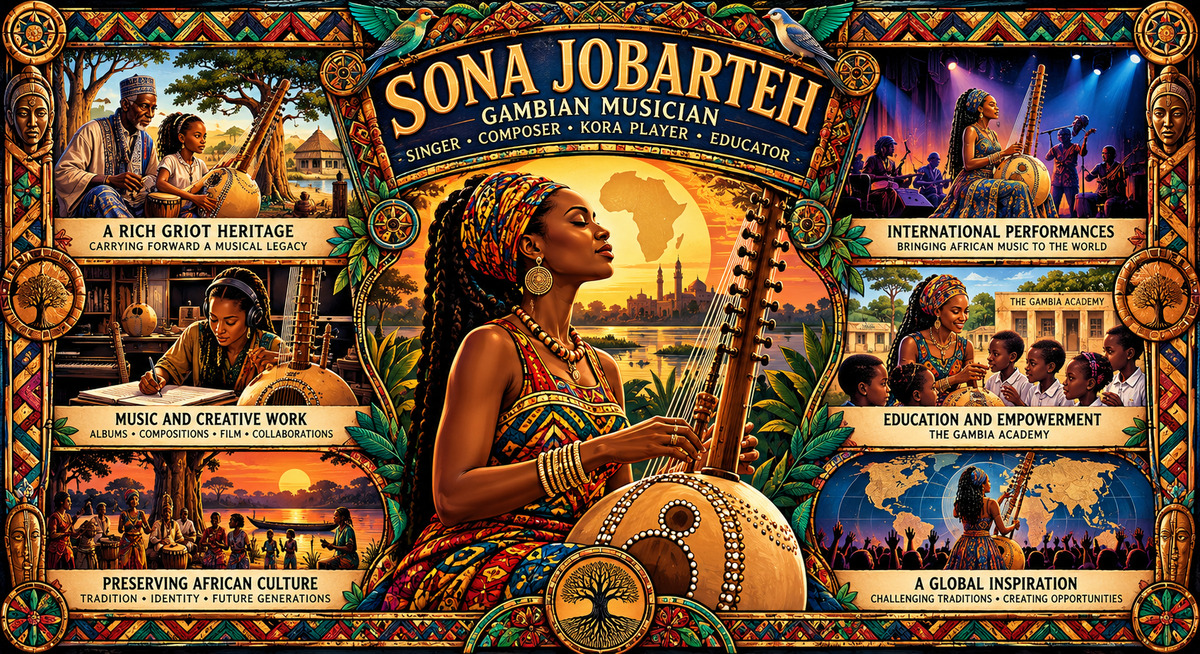
African music carries centuries of history, traditions and storytelling. Among the women helping preserve this heritage is Sona Jobarteh, a Gambian singer, composer and instrumentalist who has challenged generations of tradition through her mastery of the kora.
Recognized as the first professional female kora virtuoso from a West African griot family, Jobarteh has brought traditional Gambian music to international audiences while advocating for education and cultural preservation.
Her journey demonstrates how African women can challenge established traditions while remaining deeply connected to their cultural roots.
Who Is Sona Jobarteh?
Sona Jobarteh is a Gambian musician, composer, educator and cultural activist from a distinguished family.
Griots are traditional musicians, storytellers and custodians of oral history who preserve the cultural knowledge of their communities through generations.
Jobarteh comes from a family of renowned kora players, including her grandfather, Amadu Bansang Jobarteh, and her cousin, the celebrated Malian musician Toumani Diabaté.
According to her official biography, she became the first professional female kora virtuoso to emerge from these traditionally male-dominated musical dynasties.
Early Life and Musical Education
Growing up between The Gambia and the United Kingdom, Jobarteh experienced different musical and cultural environments.
She was introduced to the kora during childhood and later studied Western classical music in Britain.
Her education included composition at the Purcell School of Music and studies in cello, piano and harpsichord at the Royal College of Music.
Despite her classical training, Jobarteh remained committed to the musical traditions of her Gambian heritage.
Her determination to master the kora helped establish her distinctive artistic identity.
Breaking Barriers With the Kora
The kora is a traditional West African stringed instrument, commonly described as a 21-string harp-lute.
For centuries, professional kora playing was associated with hereditary griot families, with knowledge traditionally passed from fathers to sons.
Jobarteh challenged this convention by becoming a professional female performer within the tradition.
Her achievement represents an important development for women in West African music.
Rather than abandoning traditional practices, she has demonstrated that cultural preservation and women’s participation can exist together.
You can learn more about her musical journey through the University of Chicago’s profile of Sona Jobarteh.
Sona Jobarteh’s Music and Albums
Jobarteh’s music combines traditional Manding melodies with contemporary musical influences.
Her songs feature the distinctive sound of the kora alongside vocals, percussion and other instruments.
Her notable recordings include:
-
Fasiya (2011) — An album celebrating heritage and the musical traditions of West Africa.
-
Badinyaa Kumoo (2022) — A later album exploring cultural identity, social values and contemporary African experiences.
Her song Gambia is particularly associated with her celebration of Gambian culture and national identity.
Through these recordings, Jobarteh introduces listeners to African musical traditions that may otherwise receive limited international exposure.
Visit Sona Jobarteh’s official website to explore her music and performances.
International Recognition and Achievements
Jobarteh has performed at major international venues and festivals, including the Hollywood Bowl in Los Angeles, WOMAD festivals and Symphony Space in New York.
Her musical achievements extend beyond live performances.
She has contributed to film soundtracks, composed music combining African and Western instruments, and received recognition for her artistic and educational contributions.
Among her notable achievements are:
-
Becoming a pioneering professional female kora virtuoso.
-
Performing at internationally recognized music festivals.
-
Composing music for films and orchestral projects.
-
Receiving an honorary doctorate from Berklee College of Music in 2023.
-
Establishing an educational institution in The Gambia.
These accomplishments have helped position her as an important cultural ambassador for Gambian music.
The Gambia Academy: Education Through African Culture
Beyond her musical career, Sona Jobarteh is committed to improving education in Africa.
In 2015, she founded The Gambia Academy, an educational institution designed to combine academic learning with African cultural knowledge and identity.
Her approach challenges the idea that modern education must separate young Africans from their heritage.
Through the academy, Jobarteh hopes to create learning opportunities that encourage cultural pride, creativity and leadership.
This commitment to education makes her work especially relevant to Miangos’ mission of celebrating African women who contribute to their communities beyond their professional achievements.
Learn more through Sona Jobarteh’s official biography and educational projects.
Why Sona Jobarteh Matters
Sona Jobarteh’s career demonstrates that traditions can evolve without losing their cultural significance.
By mastering an instrument historically dominated by men, she has challenged expectations about women’s roles in traditional music.
At the same time, her performances, compositions and educational work help preserve Gambian musical heritage for future generations.
Her story is particularly inspiring because her influence extends beyond international recognition. She is also using her achievements to create opportunities for young Africans.
Final Thoughts
Sona Jobarteh represents an important voice in contemporary African music.
From breaking barriers in the centuries-old griot tradition to performing on international stages and establishing The Gambia Academy, her achievements demonstrate how music can contribute to cultural preservation and social change.
Her journey is a reminder that African women can honor their heritage while challenging limitations and creating new opportunities for future generations.
For readers interested in African female musicians, Gambian culture and traditional African instruments, Sona is an artist worth knowing.
You can also explore our curated collection of other influential African female musicians who have shaped the continent’s sound.
Leave a Reply