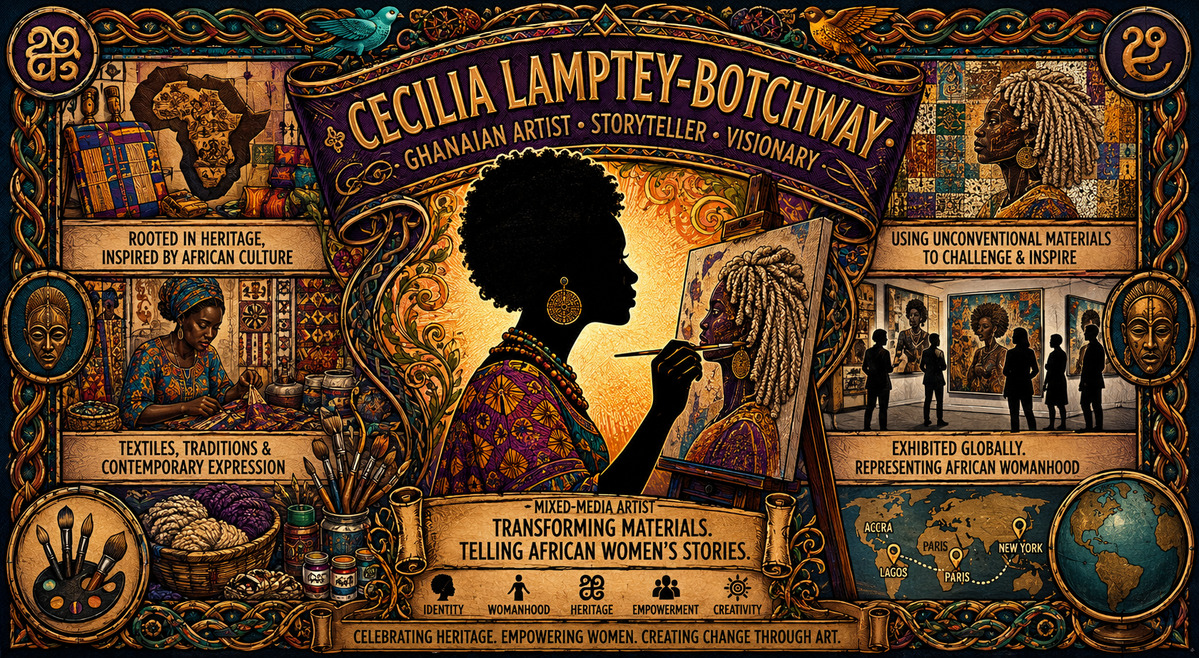
African art has never been simply about beautiful colors and striking images. For many artists, it is a way of preserving heritage, questioning social expectations, and telling stories that may otherwise be overlooked. One Ghanaian artist doing this in a particularly creative way is Cecilia Lamptey-Botchway.
A mixed-media artist based in the United States, Cecilia combines painting, textiles, performance, and unconventional materials to create powerful portraits of African women.
Her work caught my attention because she does something quite special: she takes familiar materials and cultural traditions and turns them into contemporary art that speaks about womanhood, identity, heritage, sustainability, and gender roles.
Who Is Cecilia Lamptey-Botchway?
Cecilia Lamptey-Botchway is a Ghanaian mixed-media artist whose practice includes figurative painting, performance, abstract art, and textile making.
Born in Ghana in 1992, she grew up in a family of painters and textile designers. Her childhood introduced her to painting, batik, textile making, and design—skills that would eventually become an important part of her artistic language.
She later studied at the Yaba School of Art, Design and Textiles at Yaba College of Technology in Lagos, Nigeria, graduating in 2015.
Today, Cecilia’s work connects African traditions with contemporary art while giving particular attention to the experiences of African women.
What Is Cecilia Lamptey-Botchway Known For?
One of the most fascinating aspects of Cecilia’s art is her use of mop wool and other fibers to create texture.
Yes—mop fibers.
Rather than treating these materials as ordinary household objects, Cecilia incorporates them into her portraits, creating textured hair, clothing, and other elements within her compositions.
The choice is more meaningful than it may initially appear. Her use of a material associated with domestic cleaning connects to conversations about women’s labor and traditional gender roles. Her art therefore turns an everyday object into a way of asking questions about how society views women’s work.
This combination of creativity and symbolism is one of the reasons her work stands out among contemporary African artists.
Exploring African Womanhood Through Art
Women are at the center of much of Cecilia’s artistic practice.
Her portraits often portray African women with confidence, movement, personality, and individuality. Rather than presenting women through a single stereotypical image, she explores the many ways African women experience identity and society.
Her work addresses issues including:
- Gender roles
- Womanhood
- Identity
- African heritage
- Social expectations
- Women’s labor
- Sustainability
- Community
- Beauty and self-expression
Her approach allows viewers to look at African women beyond conventional representations and consider the complexity of their experiences.
How Her Ghanaian Heritage Influences Her Art
Cecilia’s connection to African textile traditions is evident throughout her work.
Growing up around painters and textile designers exposed her to techniques such as batik and textile design. She later incorporated traditional motifs into her own contemporary compositions, creating a visual relationship between heritage and modern artistic expression.
This is important because Cecilia isn’t simply reproducing traditional African designs.
Instead, she takes elements from her cultural background and reimagines them.
Her paintings can therefore feel simultaneously familiar and contemporary—a reflection of how African culture itself continues to evolve.
Cecilia’s “Make We Dance”
One of Cecilia’s notable exhibitions was Make We Dance, a solo exhibition presented at the Nubuke Foundation in Accra, Ghana, from June to August 2022.
The exhibition explored movement, posture, and dance through paintings of dynamic African women. Cecilia used mopping wool to create additional texture in her works, while textile-inspired motifs formed important parts of the compositions.
The idea of movement is particularly interesting because her subjects don’t feel static.
They appear to be living, moving, celebrating, reflecting, and interacting.
The exhibition demonstrated how Cecilia could take traditional textile knowledge and combine it with painting and experimental materials to create something distinctly contemporary.
Taking African Art to the International Stage
Cecilia’s career has extended well beyond Ghana.
Her exhibition history includes appearances at Art X Lagos, AKAA Paris, ARCO Lisboa, Focus Art Fair New York, and 1-54 Contemporary African Art Fair in New York. Her work has also been exhibited in Europe, Africa, and the United States.
In 2025, she participated in 1-54 New York with AKKA Project, an important platform dedicated to contemporary African art and its diaspora.
Her international exhibitions show how contemporary African artists are increasingly taking their place in global art conversations rather than being viewed only through the lens of traditional African art.
Cecilia’s 2025 Art Prize Recognition
Cecilia’s recent career has continued to grow.
According to her official biography, she was the 2025 New York winner of the International Art Prize of Winsor & Newton and Paul Smith’s Foundation Art Prize. She was also a 2021–2022 fellow in the Nubuke Foundation’s Young Ghanaian Artists residency.
These achievements add to a growing body of international recognition for her work.
Her Art Continues to Evolve
Cecilia’s more recent work demonstrates that she continues to explore African identity through different materials and ideas.
In 2026, she participated in the “A Time Within A Time” exhibition at Monmouth Museum in New Jersey. Her painting Embracing: Me and My Twin Embracing Each Other for Love explores twins within the West African cultural context and reflects on ideas of unity and individual identity.
She also participated in the 16th International Festival of Visual Arts at the Lapidarium Museum in Croatia in 2025, where the exhibition focused on contemporary artists working with textiles and discarded materials.
This continued experimentation makes her an artist worth watching.
Why Cecilia Lamptey-Botchway Matters
What I find particularly compelling about Cecilia’s work is the way she refuses to separate art from everyday African life.
Her paintings bring together things that might seem unrelated:
Textiles + painting
Domestic materials + fine art
Tradition + contemporary culture
Womanhood + social commentary
African heritage + global art
That combination gives her work a personality of its own.
She also reminds us that African women can be both the subjects and creators of the stories being told about Africa.
Rather than allowing outsiders to define African womanhood, Cecilia uses her own artistic language to explore it.
Where to See Cecilia Lamptey-Botchway’s Art
Cecilia’s official website features information about her work, exhibitions, and artistic practice. You can explore her portfolio and follow her latest projects through her website.
Cecilia Lamptey-Botchway’s official website
Her exhibition history also shows appearances at institutions and art fairs across Ghana, Nigeria, France, Portugal, Germany, the United States, and Croatia.
Final Thoughts
Cecilia Lamptey-Botchway represents an exciting generation of African female artists who are taking cultural heritage into new artistic spaces.
Her work is colorful, textured, thoughtful, and sometimes surprising. But beneath the visual beauty are deeper conversations about African women, domestic labor, identity, sustainability, tradition, and the expectations placed on women.
From the textile traditions she encountered growing up to international exhibitions in New York and Europe, Cecilia’s journey demonstrates how African heritage can become the foundation for innovative contemporary art.
And perhaps that is what makes her story so inspiring.
She isn’t simply painting African women. She is creating space for African women to be seen, questioned, celebrated, and understood.
For further reading on inspiring female African creative artists, explore the African arts category on Miangos, which features profiles on trailblazers like Esther Mahlangu, Portia Zvavahera, and Aïda Muluneh.


Leave a Reply